
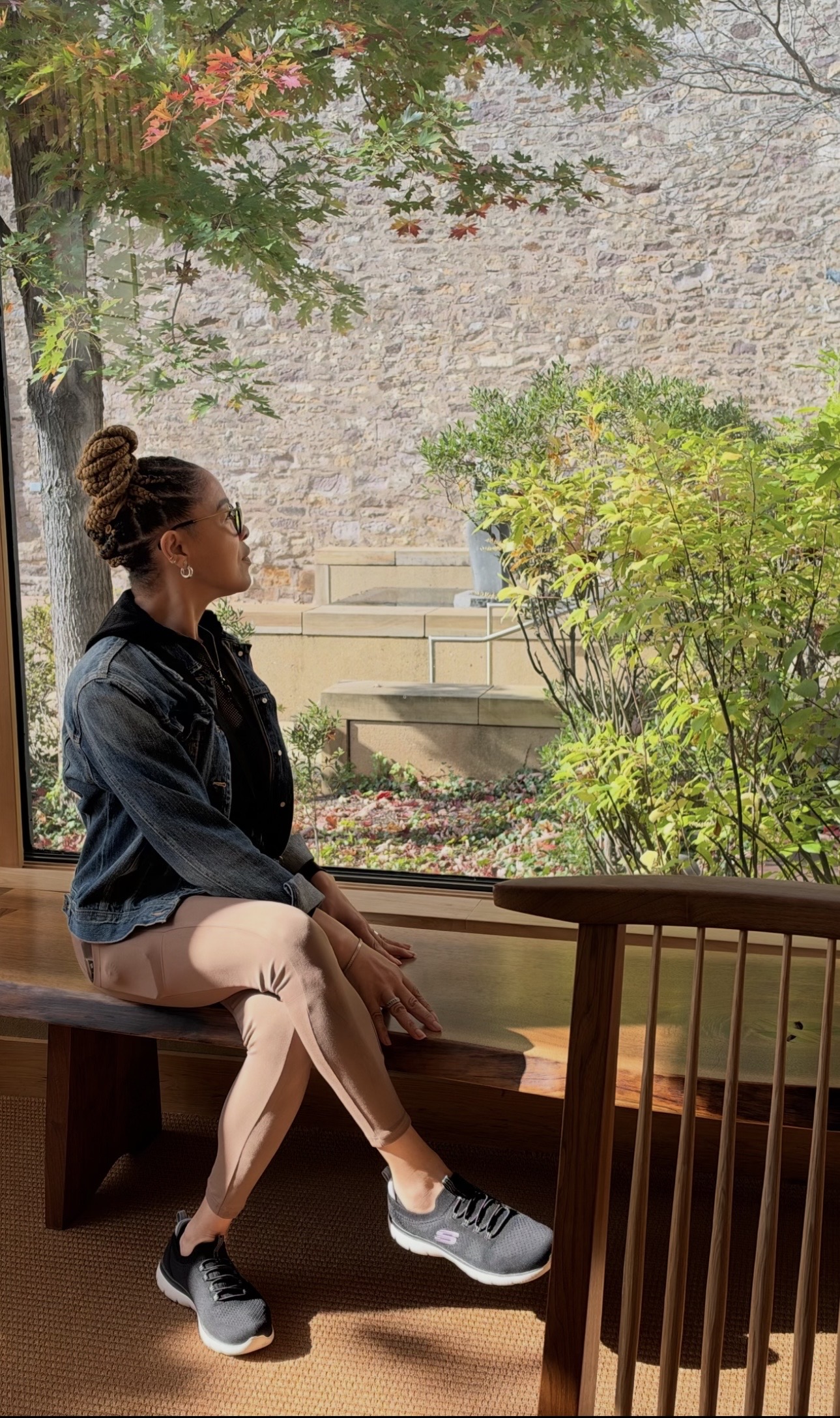
How Dr. Sheri Prentiss’s experiences with cancer, faith and service reshaped her understanding of abundance, purpose and what it means to live fully.
By: Aryana Hadjimohammadi
In 2008, Dr. Sheri Prentiss was a physician used to guiding other people through medical crises. Then she became the patient, facing an aggressive form of breast cancer while trying to reassure her two daughters. At the same time, her own mother was dying. The girls were already preparing to lose their grandmother when they learned that their mother had been diagnosed with breast cancer.
“I don’t want to be so occupied with building a meaningful life that I forget to experience the meaning already present in it,” Prentiss wrote in response to questions about how her thinking has changed.
That sentence gets at something she has spent years working out. Gratitude, for her, is no longer reserved for milestones, professional wins or seasons when life cooperates. It shows up in the ordinary hours: time in prayer, a peaceful cup of tea, an unhurried conversation with someone she loves, the freedom to decide how she’ll spend her day.
Which is a different thing than saying life has been easy. Gratitude, as she describes it, doesn’t require a life untouched by hardship. It means seeing what remains meaningful without pretending the rest didn’t happen.
Prentiss is a physician and public health specialist who founded the LIVE Today Foundation, which provides free compression garments to cancer patients and survivors living with cancer-related lymphedema who are experiencing financial hardship. Her thinking about gratitude has been shaped by losses that rearranged both her personal life and her career. But what she wants readers to take away isn’t a story about what she survived. It’s about how she lives now.
“Gratitude has evolved from something I express into something I intentionally practice,” she said. “It is no longer dependent on what happens around me; it is increasingly reflected in how I choose to live.”
Learning to notice the ordinary
“Cancer reminded me that tomorrow is not promised. Life since cancer has taught me that today is not
something to rush through on the way to tomorrow.”
That year changed how Prentiss thought about time. Credentials, accomplishments, carefully laid plans—none of it could guarantee she’d be there for the milestones she had assumed she and her daughters would share.
Her daughters are grown now. She has watched them reach moments she once couldn’t take for granted, and she sees those moments differently. Not just birthdays or graduations or accomplishments. Something closer to the gift of being there at all.
“When I think about that, I don’t simply see birthdays, celebrations, or accomplishments. I see the gift of being present,” she said.
The same appreciation carries into smaller things. A quiet morning. A real conversation. A trip somewhere new. None of it looks extraordinary from the outside, and that’s rather the point.
There was a time, Prentiss said, when she measured a day by how much she got done. Now she asks different questions: Was she present? Did her choices reflect what matters?
“Cancer reminded me that tomorrow is not promised,” Prentiss said. “Life since cancer has taught me that today is not something to rush through on the way to tomorrow.”
This isn’t an argument against ambition. She still works, still plans, still cares about doing things well. It’s more a warning against postponing your life until the goals are met.
A different measure of success
For most of her career, success meant achievement, advancement, responsibility, recognition. She worked hard and earned leadership roles she remains grateful for. But when breast cancer-related lymphedema permanently changed her ability to practice clinical medicine, she had to sit with a question she’d never needed to ask: Who was she without the work that had defined her?
“I’ve learned that a full calendar and a full life are not necessarily the same thing.”
“That question became an invitation to separate my identity from my accomplishments,” she said.
Her definition of abundance shifted. It became less about how much she could accomplish and more about whether her life matched her values. Freedom to choose where her time and energy go. Enough financial stability to support herself, give generously, travel, serve. Room to enjoy life without constantly spending her peace to get it.
The ambition didn’t disappear. Its place changed.
“I still value excellence. I still have goals. I still want to make a meaningful contribution to the world,” she said. “But I no longer believe that being constantly busy or indispensable is evidence that I’m living successfully.”
She’s also gotten more deliberate about what she says yes to. Not every request needs her. Not every open door is one she’s meant to walk through.
“I’ve learned that a full calendar and a full life are not necessarily the same thing,” Prentiss said.
Abundance, in her telling, isn’t about having everything or living without difficulty. It’s about recognizing what matters and being free enough to enjoy it.
Faith without pretending
Faith runs underneath all of this. Prentiss describes her relationship with God not as something she reaches for when things fall apart, but as the foundation she builds on.
That hasn’t meant having answers or avoiding grief. She has felt fear, disappointment and uncertainty, sometimes all at once. During treatment she was facing her own diagnosis while preparing to lose her mother. Later came lasting physical limits and other changes that altered the future she’d pictured.
Her faith gave her somewhere to bring the questions without hiding how she felt.
“Trusting God does not require understanding everything He allows,” she said.
She returns often to Philippians 4:11–13, where Paul describes learning to be content in all kinds of circumstances. What strikes her is that contentment was learned. It didn’t depend on things going according to plan. She also draws on John 10:10, reading the promise of an abundant life not as a guarantee of wealth or ease but as an invitation to purpose, wholeness, real relationships, peace and joy.
“I can thank God for His presence even when I don’t yet see the outcome. I can acknowledge His goodness while still grieving a loss. I can experience peace without having every question answered,” she said.
Gratitude, then, doesn’t require certainty about what comes next. It can sit alongside open questions and circumstances nobody would have chosen.
Purpose, and its limits
Her sense of purpose changed too, and so did the shape of her work.
“Having the capacity to help does not mean I have the responsibility to meet every need.”
After developing breast cancer-related lymphedema, Prentiss eventually had to leave clinical practice. Lymphedema is a chronic condition in which lymph fluid builds up in the body’s tissues and causes swelling, and it can follow cancer treatment, according to the National Cancer Institute.
Losing that role meant losing part of how she understood herself. Over time, though, being both a physician and a patient pointed her toward a different way to serve. That path led to the LIVE Today Foundation, which helps eligible patients and survivors get medically necessary compression garments when financial hardship puts them out of reach. Assistance depends on eligibility and available funding.
Her ministry has taken her to communities around the world, drawing on her medical training, public health background and faith.
Service has taught her something beyond the value of giving. It has taught her that helping people well requires discernment, and sometimes a boundary.
For years she was the one who solved problems and took responsibility. Those instincts served her professionally, but they also made it easy to take on too much. Now she asks whether an opportunity fits her calling, whether she has the capacity to do it well, and whether saying yes would cost her something she shouldn’t give up.
“Having the capacity to help does not mean I have the responsibility to meet every need,” she said.
She’s also thinking about how to build something that outlasts her personal involvement.
“I want to empower others, not create systems in which everyone depends on me,” Prentiss said.
That has changed how she measures service. Giving back doesn’t require running herself into the ground or proving her worth by output.
“Purpose is not measured by how much of myself I exhaust,” she said. “It is measured by how faithfully I use what God has entrusted to me.”
Gratitude and grief can coexist
If there’s one thing Prentiss wants people to hear, it’s that gratitude should never become one more expectation loaded onto someone who’s already struggling.
“A person can be profoundly grateful to be alive and still grieve the life they had before cancer.”
Survivors hear it all the time. You’re so blessed to be alive. You should just be grateful you made it through. The intentions are usually good. The effect can be to wave away the physical, emotional, financial and relational fallout that continues long after treatment ends.
A person can be grateful to be alive and still mourn the life they had before cancer. They can appreciate that treatment worked while managing lymphedema, fatigue, chronic pain or fear about what’s next. Gratitude doesn’t cancel any of that out.
“A person can be profoundly grateful to be alive and still grieve the life they had before cancer,” Prentiss said. “Those emotions are not contradictions. They are part of being human.”
Her advice is to start by being honest about what you’re experiencing, rather than trying to manufacture gratitude or measure your pain against someone else’s. When you’re able, notice what still holds meaning. A conversation. A laugh. Prayer. A stranger’s kindness.
That isn’t the same as settling. Gratitude doesn’t require accepting circumstances that could or should be better. People can appreciate the care they received and still push for better care. They can be thankful to have survived and still ask for the support survivors need.
“Gratitude is not a competition, and healing does not follow a universal timetable,” she said.
The message reaches past cancer. Anyone in a hard season should be able to say what hurts without feeling it makes them less grateful for what’s still good.
Making room
As Thanksgiving approaches, Prentiss hopes people will let go of the idea that gratitude requires a perfect year, a perfect family or a life without disappointment. The holiday, as she sees it, offers a moment to notice what matters, wherever you happen to be.
Her version of gratitude doesn’t ask anyone to celebrate hardship, or pretend loss hasn’t changed them. It asks them to hold both—the hard parts and the moments that still mean something.
“I don’t believe we honor life by pretending it has never hurt us,” she said. “I believe we honor life by refusing to let what has hurt us prevent us from recognizing what is still beautiful, meaningful, and possible.”
For Prentiss, that’s what living with gratitude comes down to. Not waiting for every circumstance to resolve, every question to get answered, every plan to work out before allowing herself to appreciate the life she has today.
“That is the greatest lesson gratitude has taught me: I don’t have to wait until every circumstance is resolved to embrace the life God has given me today.” she said.
Continue the Conversation
LIVE Today Foundation
Founded by Dr. Sheri Prentiss, LIVE Today Foundation helps eligible cancer patients and survivors living with cancer-related lymphedema access medically necessary compression garments when financial hardship creates barriers to care.
Dr. Sheri Prentiss — Official Website
Explore more of Dr. Sheri’s perspectives on faith, purpose, leadership, health, advocacy, and living an abundant life.